

Overview
What is AI Gateway?
The AI Gateway is a centralized plugin for configuring and managing AI capabilities in Backstage. It allows you to set up and manage various AI models, providers, and re-ranking capabilities that can be used across different plugins, such as AiKA.What You’ll AccomplishBy the end of this guide, you’ll have AI Gateway configured with one or more AI providers, enabling AI-powered features across your Portal instance.
Supported Providers
AI Gateway currently supports the following providers:- Anthropic - Direct access to Anthropic’s Claude models
- AWS Bedrock - Amazon’s managed service for foundation models — supports any model available in your Bedrock region, including Anthropic, Meta, and others
- Azure OpenAI - OpenAI models through Microsoft Azure infrastructure
- OpenAI - Direct access to OpenAI’s models (GPT-5.4, GPT-5, etc.)
- Cohere - Cohere’s language models and reranking capabilities
- Google Generative AI - Google’s Gemini models
- Ollama - Self-hosted open source models
Step 1: Enable AI Gateway in Portal
You can enable or disable the AI Gateway at any time through the Plugin settings page.Step 2: Configure AI Providers
We provide support for a variety of AI providers and models. You can configure these in the Plugin settings page under theAI Gateway section.
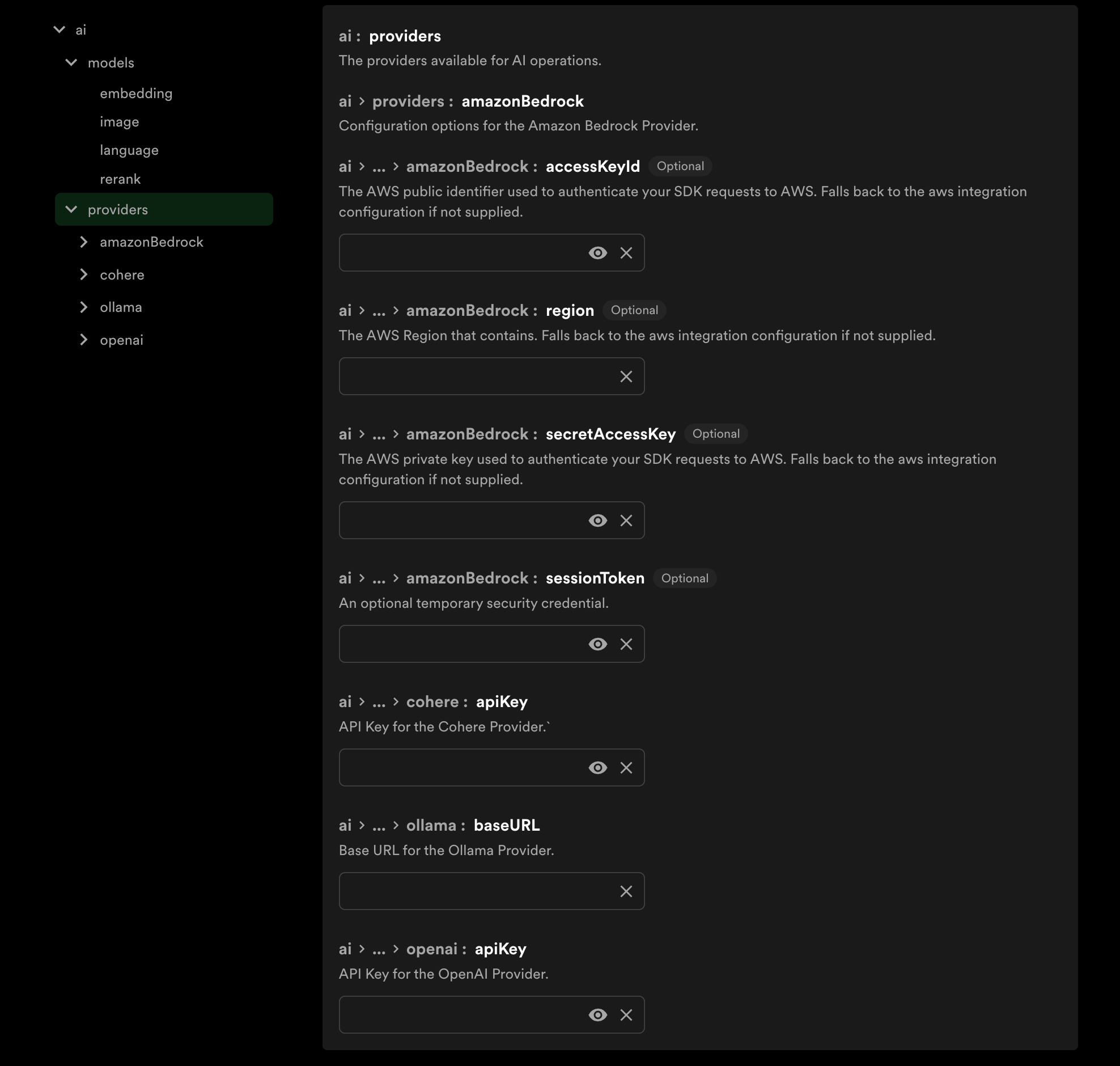
The
baseURL and headers configuration options are useful when routing
requests through a proxy or gateway. For direct connections to AI providers,
these options can be omitted and the default endpoints will be used.Provider Configuration
Navigate to Admin → Plugin Settings → AI Gateway to configure your providers.Anthropic
OpenAI
Azure OpenAI
*Either Resource Name or Base URL must be provided.
AWS Bedrock
Cohere
Google Generative AI
Ollama
Step 3: Configure Default Models (Optional)
You can set a default provider that will be used across all plugins that support AI Gateway. The model fields are formatted asprovider|model.
In the Plugin settings page under the Models section, you can configure:
Next Steps
With AI Gateway configured, you can now:- Enable AiKA for AI-powered assistance in your Portal instance
- Configure Semantic Search to use AI-powered semantic search capabilities
- Explore Provider Integrations to learn more about each provider’s specific features
- Optimize Model Selection by testing different models for your use cases